Saturday, November 8, 2025

Industry derived holistic career development process for academic institutions

This article deals with ideas on converting the momentum required for industry lead training initiative in academia. The technique involves a  structured approach and is performed in different, distinct steps. Here is an explanation of a two-step (training & placement) view. This is toward skilling needs with the potential of students’ career development from a fresher to an early career professional.
 
  • LEVERAGING  MOMENTUM, NOT ADDING WEIGHT - An Industry perspective
 A worker needs to load a heavy tire onto a truck. Instead of relying on sheer strength, he takes a smarter route—rhythmically bouncing the tire, building energy and momentum until it rises to the right height. It’s not just about force—it’s about finesse.
 
Learning works the same way. Instructional Systems Design isn’t about flooding learners with content. It’s about pacing, feedback, and interaction—each element intentionally sequenced to build momentum. Like the tire, each step helps lift the next. In learning and development, real impact comes from structure and flow, not from more content or greater pressure. Thoughtful design delivers knowledge with purpose, encourages engagement, and keeps learners moving forward.  The best learning experiences respect cognitive limits. They don’t create friction—they create lift.
 
The industry's internal development programs are structured according to the aforementioned logic of distributing responsibilities across roles. This, in turn, is customized business-wise to yield maximum benefit for scaling training and development, rather than burning out employees. A similar analogy to be applied in the academic setting is what is derived in the next section of this work.
 
  • LEVERAGING  POTENTIAL, NOT ACCESSING PERFORMANCE - An Academic Perspective
Training as a system thinking activity occurs daily. And specifically, if it happens during the adult learning stages, with a set framework, the outcomes are just the evolution itself. Thus, within the education institutions, the training program is designed according to the industry requirements with great collaboration with experts as part of the board of studies panel meeting twice a year.  An effort is also made to develop communication skills and group discussion skills so that learners can perform better in a team. In this regard, 60 hours of intensive in-house training for a year is implemented along with the academic training (AT)
 
Job readiness year on year shall be achieved with a well-rounded placement process. A pre-placement training (PT) shall be organized in the summer break for n-1 years of students' regular degree programs, just before the final nth year 1st semester. A highly structured, customized 30-hour training shall be imparted every year. Topics such as Quantitative Ability, Verbal Ability, Logical Reasoning, resume preparation mock interviews shall be covered as well.
 
Quality domain-specific interviewing techniques training sessions are to be conducted to gear up the students for group discussions on various specializations. This program enables the students to acquire sufficient knowledge to qualify in their own domains, if any, written tests of various industry requirements, and every sort of company that shall be visiting the campus during the final/ nth year’s semester onwards.
 
Guest lectures, industry visits, and special invited lecture series, workshops are organized for all the branches of students from industry experts in collaboration with respective schools through regular graduate program syllabus implementation. These trainings are aimed at improving the placement percentage year on year.
 The Training Module shall consist of the following

            Domain-specific practice and tests
            Communication Skills
            General Aptitude practice and tests
            Quantitative Reasoning
            Logical Reasoning
            Verbal Reasoning
            Group Discussion
            Interview Skills

 Here is the high-level process of the training and placement process.

 
LEVERAGING  AVENUES, NOT ONE SIZE FITS ALL
 
During the lifecycle of a student in academics, it is bound responsibility of the institutions to be a partner for every student to set the course direction of a specialized career track for each and every individual. The opportunities are looked at from graduates pursuing post-graduation, or graduates seeking employment skills for jobs. Then there is also another category of graduates who have ideas in the vein of creating something for scale to get jobs out of their entrepreneurial spirit.

 The fundamental trait for the avenues starts with communication through languages. In the context of English reading, writing, and practice is in the main flow. As the medium has are varied nature, a common language eases interpersonal communication.

 The matching of patterns in day-to-day design and such logical thinking goes under aptitude thinking. This career development exercise is to train the brain constantly to practice the logic between nature and presence. Context-based domains dominate the industry, from finance, marketing, commerce, Information technology, automotives, and supply chains, to name a few. The skills related to each of these is the need for enterprise knowledge adoption in the industry.

 CONCLUSION

The integration of an industry-derived framework into academic career development is not merely an enhancement of existing programs; it represents a paradigm shift in preparing students for the modern workforce. By moving beyond traditional academic silos to incorporate practical skills, real-world problem-solving, and critical soft skills such as communication, teamwork, and adaptability, academic institutions can ensure their graduates are not just academically proficient but also immediately employable and career-ready. The research presented here establishes a strong correlation between holistic, industry-aligned development processes and enhanced student awareness of personalized career pathways and professional identity.

The key findings underscore the significance of training and development, such as soft skills and domain-based learning, in bridging the gap between academia and industry expectations. This approach fosters a symbiotic relationship, where institutions gain valuable market insights to inform curriculum development and employers benefit from a pipeline of talent equipped with demand-driven skills. Acknowledging the cultural and structural differences between academic and job environments is crucial, and successful implementation requires strong commitment from both educational leadership and industry partners.

While this study focused on the development and initial implementation of such a model, its broader implications suggest a future where the current model serves as a foundation for sustainable, lifelong learning. Future research should explore the long-term career trajectories of students who participated in these holistic programs, using multi-institutional cohorts to improve generalizability and refine the framework. Ultimately, by embracing this integrated approach, academic institutions can empower students to navigate their professional lives effectively, equipping them with the versatility and resilience needed for sustained success in an ever-evolving global market. The time to transition from an education-centric to a career-centric model, guided by industry needs, is now, ensuring that higher education remains a vital engine for both personal fulfilment and professional growth.


Labels: ,

Thursday, October 23, 2025

Linux of the cloud is OpenStack!

Recently, I have turned back to Linux [1] as I find it overwhelming to see the potential for what OpenStack [2]  has to offer to the community. Yes, in the world of the internet, Linux made a revolution by booting any OS on any Hardware. Similarly, I see only parallels with OpenStack and such open source tools, with respect to how these can scale the computing power in the cloud and beyond. This analogy describes far more reaching of any type of computing power, even needed with mechanics to thrive in the Quantum spaces. Hence, I am writing down here are few similarities I see that help support the open source nature of both technologies. The comparison highlights several key characteristics.

  • Open Source: Just as Linux is a free and open-source operating system, OpenStack is an open-source cloud platform. This means its source code is publicly available, allowing for community collaboration, customization, and innovation.
  • Foundation for Infrastructure: Linux serves as the foundation for many operating systems and applications. Similarly, OpenStack provides the foundational Infrastructure-as-a-Service (IaaS) layer for building and managing private and public clouds. It controls and orchestrates compute, storage, and networking resources.
  • Flexibility and Customization: Linux offers immense flexibility and can be tailored to specific needs. OpenStack, with its modular architecture and numerous projects (components), also provides a high degree of flexibility, allowing organizations to build and customize their cloud environments to meet unique requirements.
  • Vendor Neutrality: Linux is not tied to a single hardware vendor, promoting choice and avoiding vendor lock-in. OpenStack similarly aims for vendor neutrality, supporting multi-vendor hardware pools and allowing organizations to choose their preferred hardware and software components.
  • Community-Driven Development: Both Linux and OpenStack benefit from large and active open-source communities that contribute to their development, maintenance, and support.
In essence, the analogy suggests that OpenStack provides an open, flexible, and community-driven platform for cloud infrastructure, much like Linux does for traditional operating systems. There will be a time when dominant cloud vendors like AWS, Google, and Microsoft, among others, assume a gatekeeper role for computing and dissolve their proprietary systems to OpenStack, as AT&T did with Unix, allowing Linux to become a powerful OS for over three decades since its invention. Red Hat [3] and Oracle [4], while settling scores themselves, the similarities will emerge for the benefit of end-users only. Ultimately, if the scientific community adopts OpenStack, industry players will follow suit. Hence, my Thesis is titled Elastic Intelligent Cloud Architecture for the academic community,[5] elucidating the frameworks that need strengthening. 

In the future, if AI holds features alongside OpenSource like OpenStack, why not Quantum Mechanics follow the same path? There is a lot of future work required to enable Quantum [6] as an open source to match and then to surpass its predecessors, like Linux, OpenStack. I welcome your comments and suggestions.

References

Labels: ,

Thursday, September 25, 2025

OpenStack could for quantum computing


Even though OpenStack does not directly manage quantum hardware, it can serve as the foundational classical infrastructure for a quantum cloud computing platform. In this article the several parameters that make the OpenStack cloud as fundamental model to extend techniques like quantamizing.


For example: 

Orchestration: An OpenStack-managed classical cloud can host the middleware and APIs that send quantum circuits to remote quantum processing units (QPUs).

Hybrid workloads: Many quantum problems are hybrid, meaning they require both classical and quantum processing. OpenStack could manage the classical portion of the workload, such as data preparation and post-processing, that runs alongside a quantum job.

Quantum simulators: Quantum simulators, which run on classical supercomputers, could be managed and made available to users through an OpenStack-based infrastructure. 

Distributed computing: In all computing requirements there is never a time one size fits for all. Coming to the way the resources discovered and distributed to only merge as qbits OpenStack cloud shall support a hybrd model.

OpenStack vs. Quantum Computing features  

Technology

An open-source suite of tools for building and managing classic cloud computing infrastructure.

An emerging technology that uses the principles of quantum mechanics (qubits, superposition, entanglement) to solve highly complex problems.

Primary Resources

Manages large pools of conventional compute (CPU/GPU), storage, and networking hardware.

Utilizes qubits, which can exist in multiple states simultaneously, to perform certain calculations exponentially faster than classical computers.

Use Cases

Deploying virtual machines and containers, managing storage, and running traditional enterprise and scientific applications.

Solving specialized problems in cryptography, drug discovery, financial modeling, and materials science.

Hardware

Runs on conventional server hardware, which can be virtualized.

Requires specialized hardware that often needs to operate in extreme environmental conditions, such as cryogenic temperatures.

Labels: ,

Thursday, June 26, 2025

A Journey Rekindled After Two Decades


A Presentation with Purpose

What began as a long and steady professional journey eventually started to feel less meaningful. It was then that pursuing a PhD brought a renewed sense of curiosity, purpose, and intellectual challenge into my life.

On a quiet morning at CHRIST University, I found myself once again behind a podium—not only as a student this time, but as a speaker, mentor, and researcher. Presenting on VM scheduling policies in a research forum, I stood before a group of curious minds and experienced faculty, sharing insights shaped over years of exploration and persistence.

An Unexpected Reunion
But the day held more than just academic exchanges. Amid the bustle of post-session chats and handshakes, a familiar face emerged—my MCA classmate from two decades ago. We greeted each other with the warmth only time can deepen. What began as a catch-up soon became a powerful moment of realization: she was not only a friend from the past but my PhD guide for the past seven years.


A Community of Scholars
We posed for group photos with our peers, fellow presenters, and organizers—some in person, while others joined virtually. Each face in the frame told a story of dedication and academic camaraderie. These were not just colleagues but co-travelers on the same challenging yet rewarding path of knowledge creation.


Capturing Bonds

As we stood together once more, smiling under the soft lights of the seminar hall, I couldn’t help but feel grateful for the chance to collaborate, for the encouragement shared through every milestone, and for the constant reminder that the best journeys are walked together.


A Milestone Preserved
Later, in a quieter corner of campus, we held the symbol of years of research—a bound PhD thesis. Surrounded by mentors and teammates, this moment celebrated more than just an academic milestone; it acknowledged resilience, teamwork, and the unbreakable bond between a student and her guide.


Gratitude, Guidance, and Growth
What began as a university friendship has grown into a mentoring relationship that continues to inspire me every day. Seven years into this PhD journey, with countless drafts, presentations, and reflections behind us, I remain deeply thankful for a friend who became my guide—and for a guide who continues to believe in me. The road ahead looks bright, especially when walked with such strong support and shared purpose.


Labels:

Saturday, June 21, 2025

AI Tools for Education

 In the previous week, I was studying the tools and techniques that can be augmented for educators. Here we could classify the tools based on the issues we need to solve. Some tools are very specific to a type of teaching. During the online teaching and learning process, the employment of such tools are part of the online meeting tools. Listed a few of them

  1. Readai is part of a Google meeting, can summarize the participants, content discussed, etc.
  2. Copilot from Microsoft, a Generative AI tool, helps by automating tasks like grading and feedback, allowing educators to focus on critical, human decisions.
  3. Kahoot!: Uses AI to create interactive quizzes and simulations. 
  4. Canva is a tool used not only for brochures but also to present classroom content.
  5. Google Gemini is very useful for generating charts of students' performance, participation, etc.
Here are few of the example for all above from the daily usage


Labels:

Saturday, May 24, 2025

Artificial Intelligence for Learning & Development

Here, I like to explore how artificial intelligence (AI) is revolutionizing corporate training by enhancing personalization, efficiency, and strategic alignment. Here is a five-point agenda that I foresee in the next 5 years.

  1. Personalized Learning Experiences: AI enables the creation of tailored training programs by analyzing individual learning patterns, preferences, and performance metrics. This personalization ensures that employees receive content that is most relevant to their roles and learning needs.

  2. Enhanced Efficiency and Cost Reduction: By automating administrative tasks such as content curation, scheduling, and progress tracking, AI reduces the workload on training managers. This automation leads to significant cost savings and allows L&D professionals to focus on more strategic initiatives.

  3. Data-Driven Insights: AI provides real-time analytics on learner engagement and progress, enabling organizations to make informed decisions about training effectiveness and areas needing improvement. These insights help in continuously refining training programs for better outcomes.

  4. Scalability of Training Programs: AI-powered platforms can efficiently scale training initiatives across large organizations, ensuring consistent learning experiences regardless of geographical locations. This scalability is crucial for maintaining uniform standards and knowledge across the workforce.

  5. Continuous Learning Culture: The integration of AI in L&D promotes a culture of continuous learning by providing employees with ongoing, accessible, and relevant learning opportunities. This approach supports employee growth and adaptability in a rapidly changing business environment.

In summary, the article highlights that incorporating AI into learning and development strategies leads to smarter, more effective training solutions that are personalized, efficient, and aligned with organizational goals.

Labels:

Sunday, January 19, 2025

OpenStack is here to stay


Berkeley, Cambridge, Melbourne, Pittsburgh, and Toronto have something in common. The university in these places invested in OpenStack the only stable and reliable open-source distributed environment. That is saving infrastructure costs. They all use it for academic record keeping, hosting research applications, class learning, delivery online, IT infrastructure management, and students and faculty access to a single cloud thereby gaining a return on investment on the IT costs. 

What is OpenStack?
As the name suggests it is a stack of open software that the customers can plug in and pay without any cost rather than the power of the internet.

How did OpenStack start?
To make the cloud affordable to common users, NASA first standardized its websites. Then the same was extended by other services for other organizations. The way it worked is based on the power and storage. Cloud computing is powerful as long as the subscriptions are active on its usage. The inherent nature of having pooled open source codes would make more consumers share their best practices.

Extending OpenStack further, IT is anticipated to implement the necessary changes to existing devices that are not constantly in use, enabling them to share their resources with others when available.

Research continuum
Once the open source software was used for base infrastructure, the researchers started contributing back to the OpenStack in these universities.


Labels: ,

Wednesday, June 16, 2021

Predictive Auto-Scaling


Prediction is to undertand the future based on current or past date. Scaling is to adjust the resources. Hence Predictive auto-scaling does simplify the future resource needs via automation. The resource needed can be CPU, Memory, Storage or even Network resources. The automation there by simplifies the provision of any of these resources for a future state. This provision can be determined also reactively, proactivly or in hybrid manner. Prediction of auto scaling factors thus works with various parameters based on the determined behaviour of the system. We will see how Amazon positions the autoscaling in predictive scenarios.


Automation is carried out in 3 ways: Amazon EC2 servers, in Application itself or with the Amazon Web Servers. Within the EC2 this auto scaling is carried out as follows : By Simple and automatic capacity provision, Scaling of infrastucture up and down, by replacment of unhealthy instances, support for various purchase options, and via balancing capacity across avaliability zones. Applications autoscaling are carried out via individual service scaling by the applications like EC2 ( Spot fleet request), ECS(Service), DynamoDB ( tables and global secondary indexes(GSI)), SageMaker(Fleet), EMR(instance group), Aurora(Cluster), AppStream 2.0(Fleet) and Custom recources. Amazon Web Servers auto scaling leverages the existing EC2 Auto Scaling and Application Auto Scaling services. Allows the application developer to define theirs based on an AWS CloudFormation stack or resource tags.


Scaling options can be of manual, scheduled or dynamic. Predictive autoscaling new feature., and uses the machine learning techniques behind the scene. The forecasting metrics are to be defined in the modeling. Where and when to use this predictive scaling has to be determined aswell upfront. It can be achieved through AWS Auto Scaling console, SDK or CFN.


Predictive auto scaling builds a scaling schedule based on historical data to provide a baseline capacity. Dynamic scaling comes next by adding capacity as needed to the baseline capacity and acts as a complement [1].


Architecture: [2]
  1. Auto Scaling Group : similar EC2 instances for scaling and to a maximum allowed
  2. Launch Configuration : provides information to instantiance EC2 instances
  3. CloudWatch : is monitoring app for metrics deviations on CPU, Memory, loads
  4. Scaling Policy: Policies set for scale in and out or scale up and down.


[1] © 2018, Amazon Web Services, Inc. or its affiliates. All rights reserved. AWS Auto Scaling How to use predictive scaling Chris Lewis Software Development Manager Amazon Web Services A P I 3 3 1 - R & A P I 3 3 1 - R 1 Usman Khalid Senior Software Development Manager Amazon Web Services

[2] M. N. A. H. Khan, Y. Liu, H. Alipour, and S. Singh, “Modeling the Autoscaling Operations in Cloud with Time Series Data,” Proceedings of the IEEE Symposium on Reliable Distributed Systems, vol. 2016-January, no. September, pp. 7–12, 2015.

Labels:

Monday, June 14, 2021

Machine Learning algorithms blogs surveyed

Motivation & Introduction:

Machine learning aim to develop computer programs that can access data and learn themselves. This automation without human interaction or intervention if mimicked similar to  the structures of brain then such programs or applications becomes an Artificial Intelligent systems. If they are as such used for constructive purpose to support technological advancements it is best way forward for human’s survival of fittest [1].

Methodology:

Questions like “Which algorithm to be used?”, “What are the types & techniques in Machine Learning algorithms?” forms the main hypothesis to be answered to through this survey[2].

Literature:

The main ideas to think for a problem solver with machine learning algorithms were: What is the Business problem, Is my Objective requirements Operational/Strategic, How will a model be implemented & Algorithms capability that matches with requirements. The 3 ways of possibility to define the requirements are: Traditional statistical techniques on fundamentals, self-learning is ML & Neural networks are deep learning.

Survey on Real-world application and Research Directions from cybersecurity, smart cities, healthcare, e-commerce, agriculture etc.,[3] is the actual motivation for anyone to start with selection and dissemination of such knowledge structures in the machine learning arena. This should start from fundamentally dealing with the hypothesis discussed here. How to Select the Right Machine Learning Algorithm [4] describes the 7 key factors to consider when you have to select the right machine learning algorithms. The basis again where to use which algorithm is dealt with in click [5].

Guide to choose the right machine learning algorithm [6]:

  •     Size of the training data 
  •     Accuracy and/or interpretability of the output
  •        Speed or Training time
  •        Linearity
  •        No. of features


Figure courtesy: Choose-ml-technique at serokell.io[7]

Essentials, Principles, Types & Examples [8]:

  •       Data Vs Algorithm – terms to understand
  •        Explainability vs Accuracy trade-offs
  •        Principle is Y=f(X) in supervised learning
  •        Types or Techniques:

o   Supervised

o   Un-Supervised

o   Semi-Supervised

o   Reinforcement 

·       Examples: Based on Space, time and Output

·       How to run ML Algorithms

     
Figure courtesy Hacker noon [9].

Commonly used ML algorithms in 2021[10]:

·       Supervised

o   Linear regression

o   Logistic regression (a subset of Neural network)

o   Decision tree, CART

o   SVM algorithm

o   Naive Bayes algorithm

o   KNN algorithm 

·       Unsupervised:

o   K-means

o   Random forest algorithm

o   Dimensionality reduction algorithms, PCA

o   Association, Apriori, ANN [11] 

·       Ensembling:

o   Ensembling (Bagging, Bootstrap sampling) [12]

o   Gradient boosting algorithm and AdaBoosting algorithm

·       Reinforcement, Q-learning, Model-based value estimations,

o   GAN, Self-trained Naive Bayes [13]


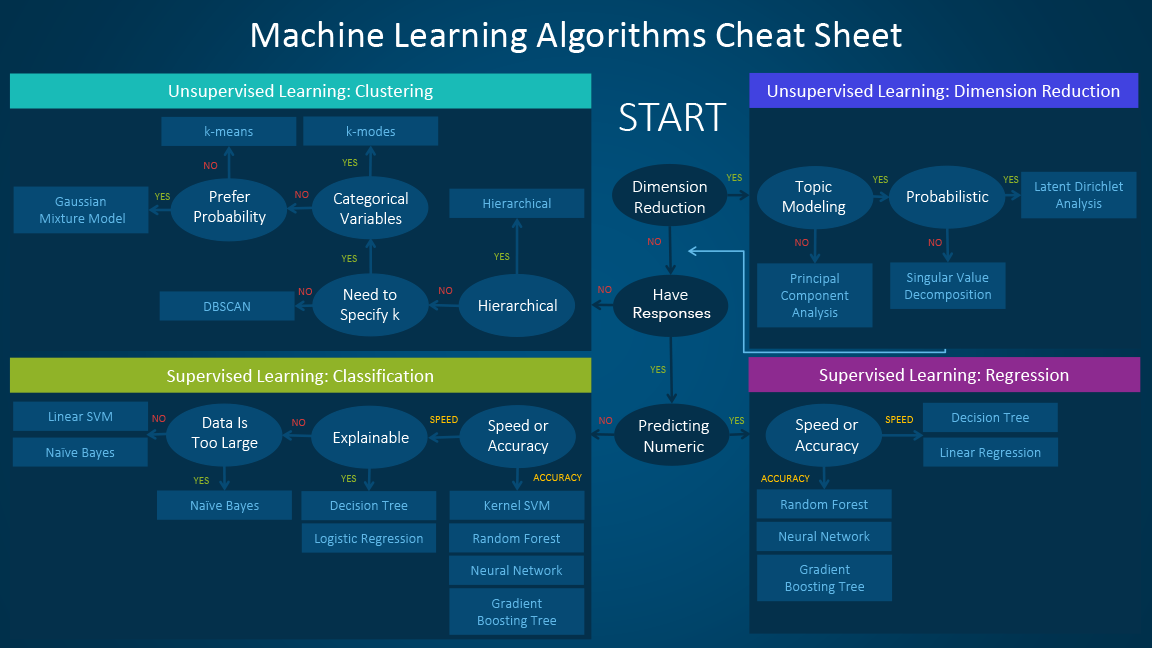
Figure courtesy: Hui Li,  ML Cheat Sheet [15] 

·        Further tour:

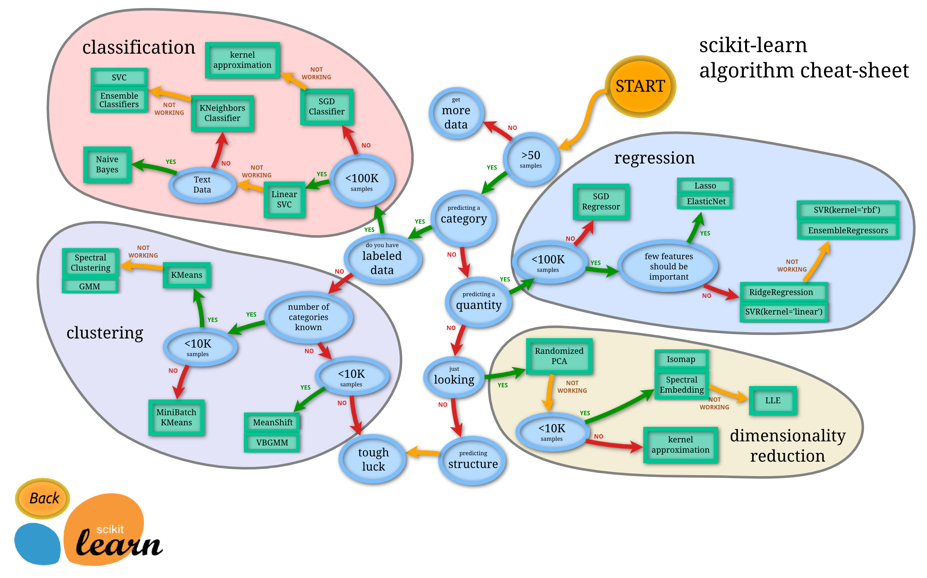
ML Algorithms goes into more detailed single algorithms under each time[14]Good works suggests trends in similar lines for all portfolios of technology and the specific one on ML gives similar  overview as all above at [17]Scikit-learn[18] cheat sheet is quiet eye-opener. Compare two or more algorithms as suggested with step by step algorithms selection with python code at [16].Good works suggests trends in similar lines for all portfolios of technology and the specific one on ML gives similar overview as all above at [17].  Scikit-learn[18] cheat sheet is quiet an eye-opener. 

Figure Courtesy Scikit-learn[18] Hacker noon

Case : for Azure ML[20] 

The use case steps suggested for setup of a business requirement from Microsoft Azure found to be practical with the available resources and parameter tuning in own cloud setup

1.       Business scenarios and the Machine Learning Algorithm Cheat Sheet

2.       Comparison of machine learning algorithms

3.       Requirements for a data science scenario

4.       Accuracy

5.       Training time

6.       Linearity

7.       Number of parameters

8.       Number of features


Case for Smarter cities:

The Digital Twin Paradigm for Smarter Systems and Environments: The Industry use cases , many of the above and Canonical correlation Analysis for feature extraction type of task [20].

Case with Experiment implementation:

Commonly used Machine Learning Algorithms (with Python and R Codes) [22].

 As final remarks of a job interview questions and the like on how to choose consists of first classify the decision into data related and problem related [21].

 Conclusion:

 The survey put forward the ideas around machine learning by answering the hypotheses on which algorithms to be picked when and what does each one do. Though the writing itself is not detailed enough, it is a good collection for answering the fundamental questions such that the reader gets an overview in the field of Machine learning.

 References:

[1]    https://www.expert.ai/blog/machine-learning-definition/

[2]    https://www.analytixlabs.co.in/blog/how-to-choose-the-best-algorithm-for-your-applied-ai-ml-solution/

[3]    Sarker, I.H. Machine Learning: Algorithms, Real-World Applications and Research Directions. SN COMPUT. SCI. 2, 160 (2021). https://doi.org/10.1007/s42979-021-00592-x

[4]    https://towardsdatascience.com/how-to-select-the-right-machine-learning-algorithm-b907a3460e6f

[5]   https://www.datacamp.com/community/news/which-machine-learning-algorithm-should-i-use-raluply88ph

[6]   https://www.kdnuggets.com/2020/05/guide-choose-right-machine-learning-algorithm.html

[7]   https://serokell.io/blog/how-to-choose-ml-technique

[8]   https://www.knowledgehut.com/blog/data-science/machine-learning-algorithms

[9]   https://hackernoon.com/choosing-the-right-machine-learning-algorithm-68126944ce1f

[10]  https://www.simplilearn.com/10-algorithms-machine-learning-engineers-need-to-know-article

[11]   https://www.dezyre.com/article/common-machine-learning-algorithms-for-beginners/202/

[12]  https://www.dataquest.io/blog/top-10-machine-learning-algorithms-for-beginners/

[13] https://searchenterpriseai.techtarget.com/feature/5-types-of-machine-learning-algorithms-you-should-know

[14]  https://machinelearningmastery.com/a-tour-of-machine-learning-algorithms/

[15] https://blogs.sas.com/content/subconsciousmusings/2020/12/09/machine-learning-algorithm-use

[16]https://analyticsindiamag.com/how-to-choose-the-best-machine-learning-algorithm-for-a-particular-problem

[17]  https://www.goodworklabs.com/machine-learning-algorithm

[18] https://hackernoon.com/hn-images/1*9gGtNn2EXW1Zog-bjdGsHQ.png

[19] https://docs.microsoft.com/en-us/azure/machine-learning/how-to-select-algorithms

[20] https://www.sciencedirect.com/topics/engineering/machine-learning-algorithm

[21] https://www.youtube.com/watch?v=gZWhVj-g8Mc

[22] https://www.analyticsvidhya.com/blog/2017/09/common-machine-learning-algorithms

Labels: ,